
Financial independence
The rest of /projections asks where your wealth is going; its last card asks how much
of it would be enough to live on. Topping up an income from your wealth or replacing the
income altogether is the same arithmetic, the one FIRE made familiar, applied to your own
figures.
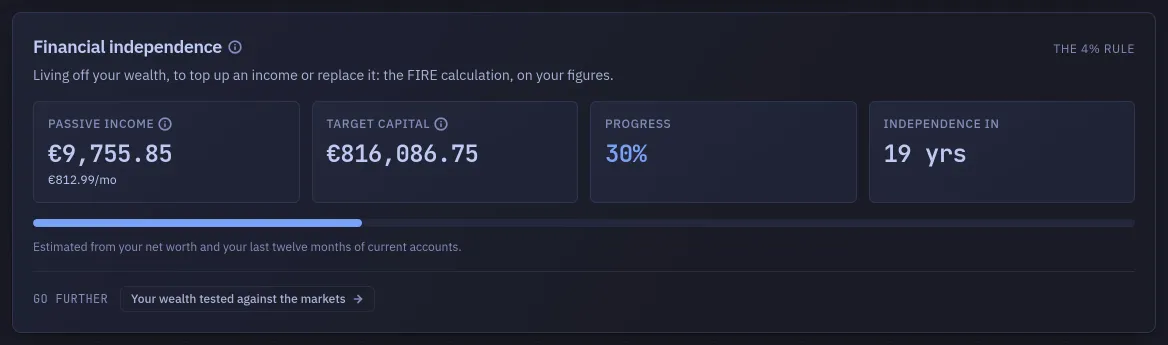
Passive income, target capital, progress and horizon
Section titled “Passive income, target capital, progress and horizon”| Tile | What it is |
|---|---|
| Passive income | What your net worth could pay a year at a 4 % withdrawal rate, and the same figure per month. |
| Target capital | The capital to reach, the one FIRE calls its number: your annual expenses divided by that same 4 %, which is 25× a year of spending. |
| Progress | Your net worth over that number, capped at 100 %. |
| Independence in | The years it takes to get there, compounding your net worth at the rate set at the top of the page and adding your annual savings. |
A progress bar under them repeats the third tile.
Your current accounts, over twelve months
Section titled “Your current accounts, over twelve months”The annual expenses come from your current accounts, over the last twelve months, read the same way the Budget screen reads them. Nothing here is typed by hand.
A short history reads as a cheap year, and a cheap year shrinks the target capital and flatters the progress. Three months of imported statements will give you a target roughly a quarter of the right one.
The whole net worth, and the sixty-year horizon
Section titled “The whole net worth, and the sixty-year horizon”The passive income applies the withdrawal rate to your whole net worth, main home included. The part you could actually draw on is smaller: a house pays no income, and selling it to live on is a different plan from the one this tile describes. Read the figure as a ceiling.
Independence in looks sixty years ahead and no further, since a horizon longer than a working life means nothing. A dash there means the rate and the savings do not get you to the number. Raise the growth rate, or look at what the savings line would have to be.
Going further
Section titled “Going further”Go further at the foot of the card opens the Monte Carlo simulator, which makes up for this card’s weakness: everything above compounds one average rate, and markets do not deliver the average every year.