
How it stays current
Badlen redoes its arithmetic every night, on your own machine. You supply what it works on: a balance when one changes, and the operations, typed, handed over by your assistant or merged from a file. Nothing in it signs in to a bank, so nothing you record leaves that machine.
There is no public instance to sign up to. To try Badlen before installing it, the online demo runs the whole application in your browser, on sample data.
Every night, on its own
Section titled “Every night, on its own”A nightly run refreshes the quote of every line you hold and records the day’s net worth. One security held inside an account is what Badlen calls a line: you declare it once, by its ISIN and a quantity, and from then on its price comes from an outside source without you typing it.

Those quotes come from a handful of public services, none of which needs an account of yours, and Where the data comes from lists each one with what it is sent. They cover ETFs, shares and funds that have an ISIN and a listing, and the coins CoinGecko lists.
A crypto wallet goes one step further. It is declared by its chain and its public address, and the Sync button on that account’s Settings tab asks the chain what the address holds. It needs no credential of yours, because a public address is not one.
Your part
Section titled “Your part”The value of a current account, a savings book, a life-insurance contract, a property or a loan is a figure you state, on a date, and correct later if it was wrong. A euro fund, an SCPI (the French unlisted property fund, shares in a landlord rather than in a building), a property, a savings book or a loan has no listing anywhere, so its value is the figure you state. Badlen keeps every stated balance and builds the history from them; it never guesses one.
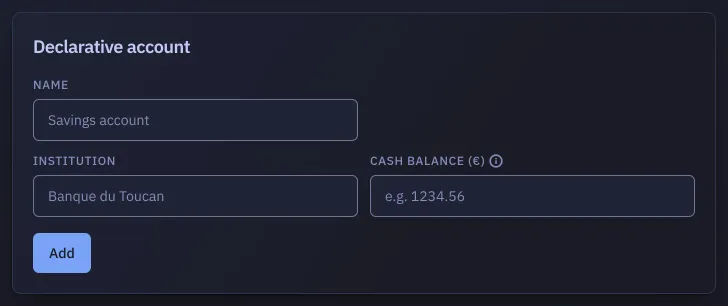
A savings book needs only one balance, entered when it changes. An account left untouched for six months shows its six-month-old balance, clearly labelled as such.
The operations are the other half, for the accounts whose every payment you want to see. They get in one of three ways, and each asks something different of you.
By hand
Section titled “By hand”Needs: nothing beyond the browser.
New operation, on Your operations, records one at a time. Each lands in the register, where you can search the bank label and the note and filter by account, category and date. By hand says which form takes what.

With your assistant
Section titled “With your assistant”Needs: an MCP client, Node on the machine it runs on, and an API key carrying the
transactions:write scope.
The client you already use reads your statements on your machine, under your own model,
and writes the operations it extracted in batches through the /api/v1 surface. Every
batch is deduplicated, after a dry run that shows what would be written. It is the way in
for a whole history at once, and
With your assistant sets it up.
Your statements ──▶ your MCP client ──▶ MCP tools ──▶ Badlen /api/v1 reads and extracts import_transactions dedup, writeFrom a file
Section titled “From a file”Needs: a JSON file in Badlen’s own format.
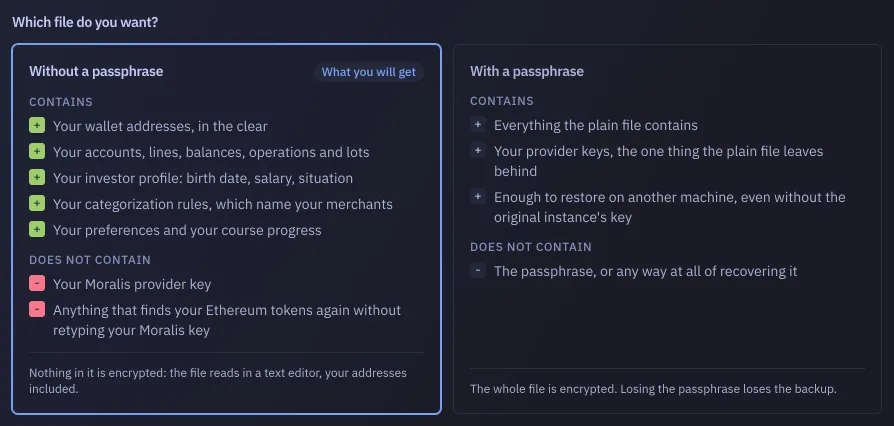
Settings → Data → Your data → Import a file merges it into your account. A Badlen export is such a file, and so is one you wrote or converted yourself: every row is matched before it is written, so the same file sent twice adds nothing. From a file describes the format.
Your accounts stay home
Section titled “Your accounts stay home”Nothing in Badlen signs in to a bank. There is no aggregator, no screen-scraper and no open-banking connector, so no bank credential of yours is ever asked for and no company you have never heard of keeps a copy of your accounts on its servers. What you record exists once, on the machine you installed Badlen on.
It is also all the law allows a self-hosted program: in the European Union a bank’s interface answers only a registered entity, identified by a certificate carrying its registration number, and no program a thousand people install on a thousand machines holds one. Why no bank sync makes the whole argument, with the legal texts and sources behind it.
Not yet
Section titled “Not yet”Each month
Section titled “Each month”What updates on its own needs nothing from you. The rest is yours: one balance per account whose value you state, and the operations, by whichever of the three ways suits you.
The project has not measured how long that takes, and it depends on what you hold: an instance of three savings books and an ETF is a few balances a quarter, one that tracks every operation on a current account is the register, every week. Nothing is due on a schedule and nothing breaks if you skip a month. The history holds the last figure you stated, labelled with the day you stated it.