
Fees
/frais adds up the cost of owning your portfolio: the fees already recorded on your
lines and operations, the ongoing charges your funds take every year, and whatever your
bank or broker bills on top. The headline figure projects those costs over twenty years,
at the average ongoing charge of what you hold.
Fees already on file
Section titled “Fees already on file”Fees paid is every fee already on file against your invested portfolio, meaning your PEAs, life-insurance contracts and securities accounts: amounts typed on their securities lines, plus the brokerage and taxes carried by their operations. The % of invested portfolio beside it divides that total by today’s invested value. It is a cumulative figure over a single day’s value, not an annual rate.
Both figures cover the same lines, otherwise the second would not be a share of the first. Crypto, your passbooks and your other accounts enter neither the total nor the value it is divided by, exactly as on Performance and in the Cost of ownership card on Advice.
By account splits the fees paid since the start between your accounts, each with its share of the total.
Fees paid per year draws the dated fees only. A fee typed on a line is a cumulative amount with no date, so it counts in the total but in no bar; when the two disagree, the card explains why underneath.
Fund ongoing charges, and platform fees
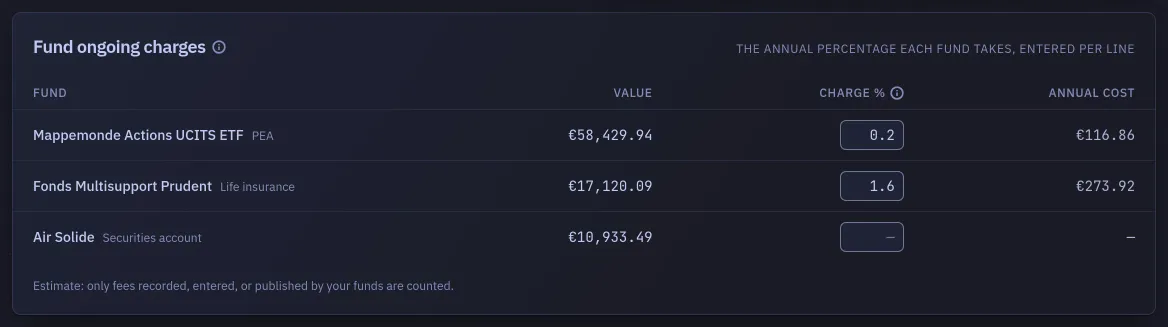
Section titled “Fund ongoing charges, and platform fees”Fund ongoing charges has one editable box per fund line: its annual charge, as a percentage between 0 and 100. It is fetched on sync when the source publishes it, and entered by hand otherwise. A broad ETF is around 0.20 %. Annual cost beside it is that rate applied to the line’s value. You can also set the rate from the line itself, under Correct, as Holdings describes.
Platform fees has one yearly box for every account you hold: open accounts first, then closed ones, listed apart under Closed accounts. Beside it, pick € for a fixed amount, such as the custody fee of a securities account, or % for a share of the account’s value, such as the management fee of a life insurance or a pension plan. A percentage is applied to the account’s value today. At the end of each row, the card says what the fee comes to a year: an amount, No fee for a zero, or Not entered while the box is empty. The placeholder is a dash, and the field stays empty until you type what your statement says: Badlen ships no rate card and guesses nothing. An amount is read in the language of the interface: in English the dot is the decimal point and a comma groups thousands, in French the comma is the decimal point. The same field sits on each account’s own Settings tab; this card lets you fill them all in one pass.
The yearly figure enters the twenty-year projection, held flat like the funds’ own charges. It does not enter Fees paid. There is no per-operation box: the commission you actually paid is typed on each order, in its Fees field.
Why every account is listed
Section titled “Why every account is listed”An account with nothing entered reads Not entered beside its name, and the footer counts them: “9 open accounts of 13 have no fees entered: these totals are a floor.” If nobody has entered an account’s fees, they are unknown, not zero. Without that mention, an empty box and a dash would read as an account that costs nothing.
If a figure is refused, the message says what format is expected: a positive number with at most two decimals for an amount, between 0 and 100 with at most four decimals for a percentage. An out-of-range ongoing charge is simply not saved, and the box keeps what you typed.